Beard growth map: find your own grain direction
“With the grain” means following the direction in which hair grows. That is not top to bottom everywhere. Neck hair may grow sideways, upwards or in a swirl. Check your own zones before deciding the direction of a stroke.
A blank map for your observations
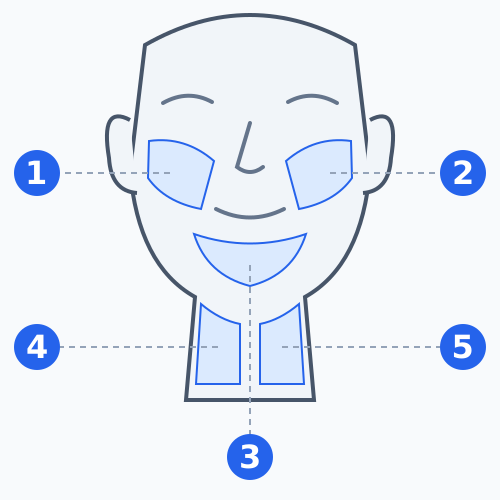
The numbers identify areas; they do not prescribe shaving directions. The left side of the drawing is not automatically the left side of your body. Use a clear orientation in your notes. Subdivide an area if the hair grows in several directions. Add the upper lip and areas beneath the jaw separately as needed.
Check one zone at a time
- Look at visible stubble in good light. On clean, dry, unbroken skin, gently feel several directions with your fingertips.
- Hair usually feels smoother when following its growth and rougher when going against it. Use both the mirror and your sense of touch. Avoid repeatedly rubbing sensitive areas firmly.
- Draw an arrow in the growth direction on your own sketch. Mark uncertain areas with a question mark rather than guessing.
- Check small neighbouring sections. Several short arrows describe a swirl more accurately than one arrow for the entire neck.
| Zone in the drawing | Your observation | For the first pass |
|---|---|---|
| 1: cheek on the left of the drawing | Note a direction or question mark | Short strokes following your observation |
| 2: cheek on the right of the drawing | Check separately; do not assume symmetry | Adapt to this zone |
| 3: chin | Split the centre and sides if needed | Small sections instead of one long stroke |
| 4: neck on the left of the drawing | Include sideways or upward growth | Start a new stroke where direction changes |
| 5: neck on the right of the drawing | Check swirls and the area beneath the jaw separately | Do not impose one direction on the whole neck |
This table is a note template, not an automatically saved form. Complete it on paper or in your own notes. Record notable zones in your shave comment if useful.
Use the map when shaving
Start with short strokes in the observed growth direction, a moist glide layer and little pressure. Start a new stroke when the direction changes. Tugging is not a reason to press harder: check the blade, angle and lather.
An additional across-the-grain pass is optional and requires calm skin. Against the grain is not a necessary goal. Stop for burning, cuts or clear irritation and allow time for recovery.
Record one observation per shave
A comment might read: “Hair in neck zone 4 grows sideways. Used only short with-the-grain strokes there today; fewer touch-ups.” This is an example, not a promised result. Keep equipment and other variables similar when comparing a change.
The map helps with planning but does not explain every skin reaction. Persistent or worsening symptoms need assessment; the symptom compass introduces the further guidance.
Read more: Shaving technique, Lather troubleshooting, 14-day programme, App quick guide.
Editorial creation: 8 October 2026 · Editor: Rasurapp. The illustration is a schematic note aid, not a universal beard growth pattern.